Showing posts with label Chemicals and Amendments. Show all posts

Tuesday, October 21, 2025

Spruce Weed and Grass Killer


Firstly, I am not rewarded for mentioning/promoting any product...perhaps one day.

Over the last few months, I have been testing a few herbicides on my property as well as my customers.

Regardless of the legal claims against Roundup and its use of glyphosate, I never found it effective.

Perhaps it is effective on a larger scale with aerial agricultural applications. Which may have led to the legal claims of harm to health.

Again, I never found it effective when attempting to kill/mitigate weeds or what I simply classify as unwanted growth.

However, on the recommendation of a customer, I have found Spruce very effective at killing/disrupting the foliage of most any weed and young plant.

The manufacturer touts it killing the roots and I don't know if it does such. The average user would not know so and I have a way of testing such, but I don't know if I will take the time to test this.

Nonetheless, visually, it seems to be the most effective weed killer I have ever used.

Of course, depending on the environ and the plant bed, its presentation or posture on your property...even if you kill unwanted growth, you may still need/want to remove by hand.

Spruce claims to be non-toxic to pets and humans.

Spruce is the best solution I have found.


Friday, January 21, 2022

Get the Jump on Spring Planning and Landscaping

Some of you have properties this well planned and maintained.

Many of you may view this as impossible, for a variety of reasons. 

Well, how about you walk your property, grab a chair, sit back and visualize the changes you can make to only one area, one aspect. Any of this is extremely possible.

This is what we do; a focused project at a time, and how most of our customers wish to address their desires for their landscape. It works - it's manageable, sane and seeing the changes made over time is quite rewarding.

Almost half-way through winter, it is a beneficial and excellent time to start putting plans together for your home's landscape. And, in this environment, here in the Midlands of South Carolina, most restoration and installation can begin way before waiting until you are inundated with the sheer maintenance of your property during the growing season and hot-as-hell summer months.

Basic Maintenance During Winter

  • Remove natural debris (leaves and needles) from your lawn if you already haven't. Turf grass still benefits greatly from sunlight and air flow this time of year.
  • Continue to edge grass borders as most grass roots still want to stretch out and grow during winter. This will prevent them from making their way into your plant beds and help maintain a manicured look.
  • Consider applying a pre-emergent for spring and summer weeds. The effective date for doing so is based on ground temperature and it sneaks up on us quite quickly in this area.
  • House those precious potted plants (particularly, tropical) inside or in a secluded area away from the wind if they will handle the ambient temperature. If you know your plant's name (genus and specie), find its climate requirements.
  • Don't wait until spring when the temperatures are nice to consider installing an irrigation system in your plant beds or lawn. This isn't Alaska - most of this can be done this time of year. And, if you wait, you may be put off in scheduling by contractors and may pay much more simply due to demand because many homeowners simply don't think about this until is almost warm and sunny.
Winter Restoration and Enhancements 
  • Pruning (On this subject, I can provide plenty of testament and references.) Pruning of most any plant for health reasons, even for aesthetics/shaping, can be performed most any time of year on most any plant. Try to forgive what your parents, grandparents or even your favorite publication says.
  • Take a look at the growth of your different plant beds and the growth they have experienced. If you are pleased with their growth and your landscape can accommodate such, then consider extending and re-establishing the bed borders to obtain/maintain a clean and clear appearance.
  • Consider those trees and larger tree-like shrubs encroaching your home or its roof. Hacking them at what you believe is the proper height is only going to create a more troublesome future mess. They need to be properly pruned or removed.
  • Also, consider those plants which obscure your view when pulling out of your driveway or those many shrubs and trees which block the view of stops signs and intersections on so many streets in this area.
  • Plan for Spring This is a wonderful time for planning and perhaps executing some changes for your property. I have had a few customers get behind the eight ball and then expect the unexpected in regard to plant availability. I get it. I often don't know until the request is made. Two of my favorite nurseries will find almost anything I ask of them, but their growers can only do so much with a given plant during a season or the year. Plants don't grow on trees - I love saying that. You get the point.
  • Refresh or replace (more in a moment) the mulch in your beds since most of the leaf and needle drop has occurred. Mulch provides so much for a plant bed or natural area. Most homeowners apply such for aesthetics. That's great. But, most mulch, properly chosen, in this area, provides shade from the sun for the ground - the base of the plant, water retention and decomposition which aids all the plants in the plant bed. In regard to replacing mulch, I am not saying this should never be done, but in most cases, it shouldn't. The decomposition from the existing mulch is so beneficial - this is one (just one) of the reasons plant bed soil is usually healthier than that in lawns. Just refresh the existing mulch, let it settle and continue the composting process.
  • Take the time to consider when you would like to pressure wash your home, decks or patios and apply a stain or sealant - when you'd feel comfortable doing so, weather-wise. Warmer months are obviously more comfortable to do so, but applying stain in too-warm conditions can be less effective in regard to penetration of the chemicals.
  • Consider ground lighting. Show off your home's architecture, its plants, both. Add some safety and security to your home living. 

If you need assistance with any of the aforementioned or a comprehensive solution based on your needs or desires, please contact Doug at 803-553-5757 or use the Contact form to the right.


Wednesday, February 3, 2021

Black Sooty Mold on Plants, Revisited...A Solution

Black Sooty Mold on Camellia Leaves
I addressed black sooty mold not so long ago in another article; however, a few instances in the last months of last year caused me to revisit this issue.

I can do my best to recall all I've learned and then study more, yet the plant world is ever-changing in its given region.

Not that this be the case in hand, but most black sooty mold I have experienced had been on large-leaf shrubs, typically understory plants surrounded by larger shrubs or trees in areas with little airflow.

Last fall I had several customers with plants in open, airy, well-sunlit areas which were inundated with black sooty mold. All were crepe myrtles. Don't be alarmed if you have one or more on you property. Crepe myrtles are hardy and deciduous plants, which is a plus in this case.

Black sooty mold is usually found on the tops of leaves, the cuticle. It has a sooty, almost fuzzy, crusty or even slimy texture and is the result of fungus which feeds on the honeydew (excrement) left behind by aphids, whiteflies or scale. (Assholes, literally) There are other suspects as well which you or someone else may not notice unless you or they are in the right place at the right time. It is amazing how much excrement such tiny creatures can produce as they enjoy the liquids of your plants they suck from them. Then again, this is testament to how much plants transpire and respire all they need and what they don't use.

The good news is:
  • The problem is only foliar, not systemic.
  • The suspects don't usually suck enough of those nutrients from your plant to cause its demise, although it may kill leaves, cause much ugliness and leaf drop.
  • If the plant is deciduous, the problem (not necessarily the residue left behind on the bark) will go away when the plant naturally drop leaves.
  • You can remove the black sooty mold, but it may take more work than you wish to do on a Sunday afternoon...more in a moment.
  • There is a (systemic, yes) solution...at least my customers say so. And, from what I know, it should work...more in a moment.
Black Sooty Mold on Crepe Myrtle
The image you see is an infected crepe myrtle on one of my customer's properties.

This is nowhere near the coverage I experienced on another customer's property, whereas it covered nearly ten feet of the tree. The surrounding jasmine, pittosporums, ivy and other plants were not grateful one bit for the gift they had received. All were severely blackened, unattractive, but still living. I just worked on them all last week.

You can easily identify black sooty mold by being able to scrape it away from the foliage and it can be removed by using a mild soap (not a detergent or degreaser), letting the soap solution remain until it loosens/breaks up the mold and then rinsing with water. A little pressure behind the water (not your pressure washer) and perhaps a little hand-to-leaf combat may be needed.

This is quite arduous, but the best approach, if you notice the culprits before such occurs, is to apply a natural oil, such as neem oil, to the leaves, but it most likely won't prevent them from returning. (This does work well on white mildew...more in a moment.)

Sometimes, we need to go with man-made prevention.

I have two customers who use BioAdvanced Tree and Shrub Protect & Feed and they are pleased with the results. It was established in the U.S. by Bayer. The active ingredient is Imidacloprid, which is a neurotoxin and is safe for most applications (Read label instructions.) when used properly and is actually used for pest (mainly fleas) treatment on animals. Be mindful around bodies of water with invertebrate fish. And if you are a honey bee keeper, don't spray it in your hive. Seriously, please read the label instructions. I don't want to write another article on the so-called global bee decline.

Mold versus Mildew 

No one wants either, mold or mildew, in their home, on their plants or in their lives. Either one, typically spawns, grows and enjoys moist conditions. 

Without much detail; mold is typically black or green, growing upward and downward, often corrupting or infecting its host while mildew is usually white and remains aligned with the surface of its host.

Mildew is a type of mold, often called, "Pre-stage mold". To learn more, please go to https://molekule.science/mildew-vs-mold-difference/. 

On plants, I usually find white mildew on the underside of large leaf shrubs, such as sasanquas, in areas with poor airflow and limited sunlight. For these situations, I usually apply neem oil, perhaps twice and then remove with high pressure water and perhaps by some hand cleaning.

A common error is to confuse white mildew with scale. White mildew will usually spread white residue and not feel course if rubbed with your thumb, while scale will feel more course and not show any residue. If you have good eyesight or have a magnifying glass, you can look at the leaf in-line with its edge (margin) and will notice some elevation above the leaf surface.

This would be scale, a pest, which may produce black sooty mold over time, perhaps not much time. I don't know. I have seen plants without black sooty mold look completed covered in several weeks.

Hey, this is not an exciting topic, but it may help you have a healthier and prettier landscape.

If you need help with this or any other aspect of your plants, please contact me.

Doug Ingbretsen
803-553-5757
service@back40.us


Friday, April 24, 2020

Plant Bed Re-work - Phase Two, Final


Before
This is phase two or the final phase of the plant bed re-work project which I first wrote of here, at Plant Bed Re-work - Phase One.

In phase two we planted a dwarf weeping japanese maple and several coleus of varying colors and variegation. We also moved a fatsia and transplanted several irises the customer was gifted from a friend. In due time, the coleus will gain height and width and add a beautiful mix of colors to the bed.
After

Other Bed - Before
Before coming back for phase two, we stopped by to help lower the high pH (see Plant Bed Re-work - Phase One.) of the bed by applying a soil acidifier, while we worked on another bed.

When we found this (the other) bed it was, for the most part, a bunch of cast iron (aspidistra) plants and some variegated monkey grass (liriope muscari variegata).

The new golden mop threadleaf false cypress is a focal point from one point-of-view, while the remainder of the bed features a farfugium plant surrounded by a mix of varying species of hosta and coral bells (huchera).
Other Bed - After

The cast iron plants were moved rearward, closer to the pine tree.

The foreground of the golden mop is an arc of purple shamrock (very young, not visible), with the also-young variegated monkey grass filling the corner.

With time and growth, this will be an interesting mix of colors, shapes and textures.

We also fertilized and amended the soil with calcitic limestone plus soil moisture retention to slightly raise the pH.

Cordyline Fruticosa and Sweet Potato Vine in The Killer Pot
I was then off to place a cordyline fruticosa and some sweet potato vine in this killer kettle-shaped pot with its patina from some tastefully ornate metal wrapped around its girth. Soon, the sweet potato vine will be climbing up and out of the pot and heading groundward for the owner to do what he best sees fit.

Last, but not least, was one of my favorite plants, a lady banks rose, needing one of my favorite things to do, prune.

This girl was going crazy, not behaving and needing some control, some guidance. See She's a Lady. Well, Perhaps Not So Much.

I contacted a few providers and narrowed the choice of trellises to a few. Trellises are those things you usually want to see and touch before your purchase, so I contacted the customer and he chose my favorite after seeing them.

Lady Banks - Before
This trellis isn't too ornate and has a simple design. You don't want the backdrops for your plants being more attractive than them. And, you particularly don't want to do so with a lady banks rose as these uppity and gorgeous things are vengeful if you try to show them up. However; they still need assistance and this one needed mine, badly.

I firmly secured a few of the most mature canes to the trellis and then I tried to train the other less-mature branches/canes to the trellis. I then pruned for health reasons and aesthetics, having this girl cascade gracefully rather than dragging her heels on the carpet.

Lady Banks - After
Planning landscapes, beds and vignettes and caring for plants can be risky. But, usually those risks are minimal - far outweighed by the rewards.

Take positive advantage of that little world surrounding you.


Thursday, February 6, 2020

Plant Bed Re-work - Phase One

Phase One - After
Phase One - After
This customer contacted me with several concerns.

We chatted and walked his property. There were some interesting plants, beds and many concerns.

Some foundation plants were harmed by someone who cleaned the roof, but that's for another time.

As usual, I wanted to find that one priority area of the customer's for which to begin. It (the before photo), the bed to re-work, was installed by another party over a year ago.

This is just phase one, so please bear with me.

If this had been a well-established bed prior, I probably wouldn't have recommended a soil test. I'm glad I did. Firstly, when we went to take soil samples, we were digging through roughly three to four inches of compost to get to the top soil - not good.

Phase One - Before
Phase One - Before
Secondly, the soil test results revealed the soil was too alkaline (pH 7.9) by several points - not common in this area.

I wouldn't have been so concerned specifically with this bed had the test results for nearby soil not been acidic (common in this area) by a great difference.

Most plants do well in acidic soil (pH 5.5 to 7.0). Something had been introduced to this bed to increase the pH - most likely, this large amount of compost.

Compost should be used during planting, worked into to soil (not roto-tilled except for something like a vegetable garden) or lightly layered - incorporated or not so predominant. Compost is not truly decomposed (will, eventually) when we buy it and it goes through large pH swings in the process. Slight changes are usually fine.

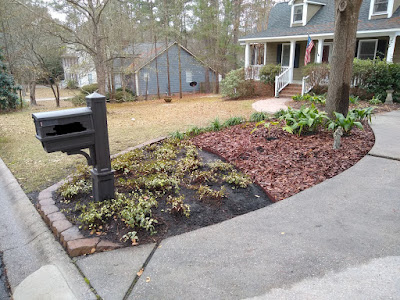
I do like the location, border and grade of the bed; however, this is a fairly shaded lot so plant selection and placement is key. To allow more sunlight and a wider selection of plants we raised the canopy of the tree and made some heading cuts on some of the other branches.

I'm not a big fan of dyed (mostly safe chemicals are used) mulches because I don't find these red and black colors in nature and mulches are mostly natural, or should appear so. However; I have seen some attractive beds using dyed mulches. To me, aesthetically, this has to do with the man-made and natural surroundings.
Phase One - After
Phase One - After

Black, double hammered (shredded, actually) hardwood mulch was in the existing bed. I have nothing against this type of mulch (it has its benefits), particularly in evergreen and/or herbaceous perennial beds with no nearby deciduous trees or shrubs. It is not so easy to clean leaf and needle debris from. Medium pine bark nuggets were chosen for the re-work.


Something was askew with the plant layout - some grouping and lines I couldn't understand:

  • Asiatic jasmine grouped, but too scattered/sparse. There were some in the rear of the bed as if they were specimen plants - gorgeous, but they aren't stand-alone specimens. Asiatic jasmine can be a wonderful ground cover bed when planted close enough to one another. There was also a cordyline plant in the midst of them. We grouped them closer together, provided no mulch to allow them to better root as they spread and installed metal edging on one side to keep the other mulch out and allow for easier edging in the future. Eventually, the asiatic jasmine will develop into a single dense bed, hugging and trailing the mailbox.
  • The monkey grass (Liriope muscata - non-spreading species) was lined up like little soldiers. This type of liriope does well along borders, so we moved them.
  • Where I expected to see some symmetry, I didn't. The cast iron (Aspidistra elatior) plants around the tree, seemed to be haphazardly placed. We rearranged these.
  • We also moved some daffodils from around the mailbox to a corner in the rear of the bed.
The remainder of the mulched area is intended to be the plant playground for the customer. There are already a few Coral Bell (Huchera) - all the same species and color, for some reason; one or two ferns and a Fatsia; and now, the Cordyline we transplanted.

The customer wants to add some color and some height in the coming weeks or months. A deep red or burgundy dwarf japanese maple was discussed. There are other options, perhaps some colorful perennials and/or some annuals, depending on the desire to replant each year, in the latter case.

I would like to show foliage and some blooms throughout most of the year. This will mean less maintenance, yet may not provide the more dynamic, yet shorter-lived blooms of some annuals - the customer's call. He seems prepared for dealing with colorful annuals, so the options have broadened. We'll support him, either way.   

All the existing plants can be transplanted easily to accommodate new plants and a new layout. Hopefully, the soil conditions will recover and the pH of the soil will approach neutral or slightly acidic over time, better accommodating the existing and new plants.

This coming summer will be the test, but next summer may best show, summarize and highlight the customer's and our efforts.

I will always love dealing with existing plants, shrubs and trees - pruning and the care of, but planning a plant bed and orchestrating its installation is terribly rewarding.

For me, it is still one step at a time and I usually have to await the full benefit of our efforts when installing new plant beds. But, we (us) can plan and try to influence Mother Nature all we want, but She still makes the rules.  

Wednesday, January 15, 2020

Mary, Mary, Quite Contrary, How Does Your Garden Grow? (Have Your Soil Tested!)

Beautiful, Well Planned Mixed Foundation Plant Bed. And, Well-Bordered. Didn't Occur Overnight...Be Patient
How did Mary's garden grow?

Well, it was probably due to good soil, but perhaps some other factors. Yet, soil quality is the far most common denominator in the life and success of most any plant.

I have no clue as to what Mary knew of her garden, its plants and soil. It appears she knew enough or had quite a way with gardening.

Perhaps she was just lucky or she had quite that the fan base for other reasons. They (someone) didn't write a nursery rhyme about her for no reason. She had something going on.

I doubt if this was sheer luck - her successful gardening, unless she inherited this mature, well established plot of land and its vivacious vegetative and floral inhabitants. Mary knew something!

And, she probably understood soil and it importance, above all else, in regard to plants and lawns (plants, as well, duh), although she probably hired out the lawn care.

I'm going with the thought that Mary was quite the savvy and educated plant person - simply not an admirer of plants, their beauty and their names. Mary was one smart woman and she also understood:
  • She could not simply look at soil and assume its health and nutrient content.
  • That a so-called, balanced fertilizer, technically, held no value in regard to the health of her plant's soil.
  • That almost all the specialized fertilizers were purely marketing ploys as almost all plants need the same levels, ratios and amounts of nutrients.
  • That there is no such thing as plant food, as cute and attractive as it may seem. Plants don't eat food. They make their own food, primarily from nutrients in the soil, along with certain amounts of water and sunlight.
  • She could throw all the amendments and fertilizers (possibly causing harm) into her garden or plants bed's soil and none of this would make much of a difference if the pH of the soil was lacking or completely off-the-chart.
  • She would need to cover her gardens with mulch for protection from severe sunlight and heat, and to retain moisture.
  • That providing a covering of mulch would also decompose over time and provide additional benefits to the soil. 
Above all, Mary understood one thing: "If I have no idea about the condition and health of my plant's (lawns, as well) soil, then it would be best if I do nothing at all." And, she's absolutely, correct!

Mary also knew the only way she could know what her soil needed (its composition, what it lacked, what it needed and its pH level) was to have it tested.

Back40 Landscape Restoration and Maintenance provides soil sample testing and a follow-up Report and Recommendations which includes:
  • Technical Soil Test Results from a Certified Lab which would be useless to you without the following:
  • Relaying these findings in terms you can understand and use, such as:
  • Soil Characteristics - its physical make-up and its ability to retain, transfer or lose nutrients and water. There is also another chemical/electrical characteristic (CEC) here which plays into pH adjustment - very key to soil health.
  • pH Level - where your soils pH level is and how easily (or not) it will respond to adjustment.
  • pH Adjustment Recommendations - what it takes and over what time to raise (typical in this area) or lower your soil's pH.
  • Nutrients - what levels of nutrients are present in your plant's soil - lacking, high or optimal (just fine) 
  • Nutrient/Fertilizer Recommendations - what your plant's soil need and how often - when to begin. 
We are offering these services at the following rates within a four mile radius of downtown Forest Acres (wherever that is). There may be a slight adjustment for travel outside this area. Several soil extractions are taken from a given area; such as front yard, foundation plant bed, etc. and those areas are considered a single test/sampling.
____________

Initial test/sampling on a given property is $30.00.

Each additional test/sampling on the same property during the same visit is $15.00.
_____________

The customer receives a comprehensive Soil Test Results and Recommendations document in MS Word format via e-mail within one week after we receive results from the lab.

Yes, Back40 Landscape Restoration and Maintenance does other things - all tree, shrub, plant and plant bed, and other property health and aesthetic type things. How often do I need to state such obviousness? Geez.

Note 1: pH adjustments to soil can be made throughout the year and are best done as soon as recognized/needed.

Note 2: Fertilization and similar adjustments are mostly dictated by the growing season and occasionally a unique plant type, yet there may be other fertilizations and adjustments in lesser or other blends/proportions which may be beneficial afterward and prior to a plant's dormant period.

Oh, if you didn't know, the last lines of the nursery rhyme are:

With silver bells, and cockle shells,
And pretty maids all in a row

And, the Eagles did a wonderful job with the last line...beautiful song on Hotel California:

Sunday, September 10, 2017

Fall Pre-emergence Application - Now's the Time

Stinging Nettle
Now, mid-September, is about the time to address winter weeds by applying a pre-emergent herbicide.

There are several pre-emergent herbicide products formulated to address a wide variety of weeds.

Another common lawn care practice is applying potash or a potassium only fertilizer during the fall to help your turfgrass have a healthy winter and ready for spring.

Nitrogen should not be applied beyond August and phosphorous should not be either unless you absolutely know, from a soil test, that you have a deficiency of phosphorous in your soil.

Last year I applied a 0-0-7 fertilizer which contains a pre-emergent. I was slightly late with the application the first week of October, but I still had positive results. This product was manufactured by Lesco and is available from Home Depot. There are other similar products out there, yet not to the extent of pre-emergence-only products. But, you only have to make one application instead of two with the combination product.

Having a good estimate of your lawn and/or plant bed square footage and the recommended settings for your spreader will be helpful.

As always, read in entirety, the label of any lawn care product before purchasing or using. Not all retailers display both the front and back labels of all products on-line, but you can usually find them on-line by entering "product name" label in the search field.

Perhaps, after hurricane Irma does what she has planned and Jose makes up his mind, we can get out there and spend a few minutes taking care of our lawns for the coming year.

Thursday, December 15, 2016

Nemo? No, Neem Oil!

Nemo
I have the hardest time not saying such, but it "ain't" a cute little fish.
It is a natural product which can act as a fungicide, miticide and pesticide, and has many other uses in products which you already use, but probably weren't aware.
We recently gave and are still giving a mix of this to our customers who spend time with their plants. The strength of mix we gave will act as a fungicide and as a miticide for some mites, but may be kicked up just a little to take care of other mites and act more as a pesticide.
Whether or not you are one of our customers, you may want to check out the following to learn more about Nemo. I mean neem oil: http://www.gardeningknowhow.com/…/pestici…/neem-oil-uses.htm.
And, as always, read the manufacturer's information before use and mixing.
Happy hindrance hunting. Oh, it won't harm fish, or much any other animal, in the strengths for the above uses. In fact, it’s probably much safer than anything else you have out in the shed.

Monday, November 7, 2016

Want to Compost? Richland County has a Solution.

Composter

Most gardeners know the advantages of compost and composting. And, many of their friends somewhat do when they are asked to save most any table scrap or food refuse for them to place in their friends compost bin.
Simply put, what comes from or is produced from the earth and soil is so beneficial to what will soon be produced from the earth and soil. This is recycling in the most basic and germane sense.
For more detail information on composting, please go to the Clemson Extension Service website and enter "composting" in the search field.